
Why “What a Piece of Work”?
It’s a wonderfully contradictory idiom and a quote from one of my favorite speeches in Hamlet.
When used to describe an inanimate object or creation, “piece of work” is an admiring or at least neutral phrase: the thing described is complex, of note, of value.

When used to describe a person, “piece of work” carries an air of exasperation and can be either complimentary or derogatory: the person described is complex, of note, difficult.

Both of those are compelling. Either creating or being a piece of work is a meaningful and willful act.
Hamlet on Humanity

Hamlet is a deeply humanist play that cares enormously about what people think and feel, but a little less about what they actually do. Most of the major action in the play happens off-stage, or is thwarted almost immediately:
- Old King Hamlet is murdered before the play begins
- Hamlet almost kills King Claudius in the third act, but abruptly decides not to
- Laertes storms the castle with a mob (mostly offstage) and almost kills and usurps Claudius, but is abruptly convinced not to
- Ophelia kills herself offstage
- Pirates attack Hamlet’s ship, and in the melee Hamlet crosses to the pirate ship and convinces them to return him to Denmark, all offstage
- Hamlet engineers the death of his two closest friends offstage
- Fortinbras’s army invades Denmark and battles through Elsinore offstage
- Fortinbras takes control of Denmark after Hamlet’s death in a quick scene that’s usually cut
Potential is weightier than action.
We know what we are, but know not what we may be.
Ophelia (Hamlet 4.5)
The Speech
In Act 2, Scene 2, Hamlet is approached by two of his oldest friends, Rosencrantz and Guildenstern. They’ve been sent by King Claudius to spy on Hamlet, an incredible betrayal, and Hamlet asks only that they admit it and explain why: “If you love me, hold not off.”
When R & G are unwilling or unable to explain, Hamlet offers plausible motivations for both Claudius’s behavior and his own: Claudius is worried about Hamlet’s state of mind, and Hamlet is depressed.
Hamlet starts: “I have of late—but wherefore I know not—lost all my mirth, forgone all custom of exercises…”
This speech, like many of Hamlet’s big moments, is beautifully ambiguous, and I think it works best when it begins as a performance and ends as an outpouring of accidental honesty.
The wherefore is obvious to the audience: Hamlet lost his father, and his father’s ghost claims that he was murdered by Claudius and Hamlet must revenge him. Later Hamlet claims that he had been in “continual practice” of sword fighting during this period, so he isn’t forgoing exercise, either.

Hamlet goes into more detail on his depression, and how “indeed it goes so heavily with my disposition that this goodly frame, the earth, seems to me a sterile promontory.“ The world, he claims, is flat and lifeless, and so too are the people in it: mankind may be “the beauty of the world, the paragon of animals,” but Hamlet declares that “Man delights not me.”
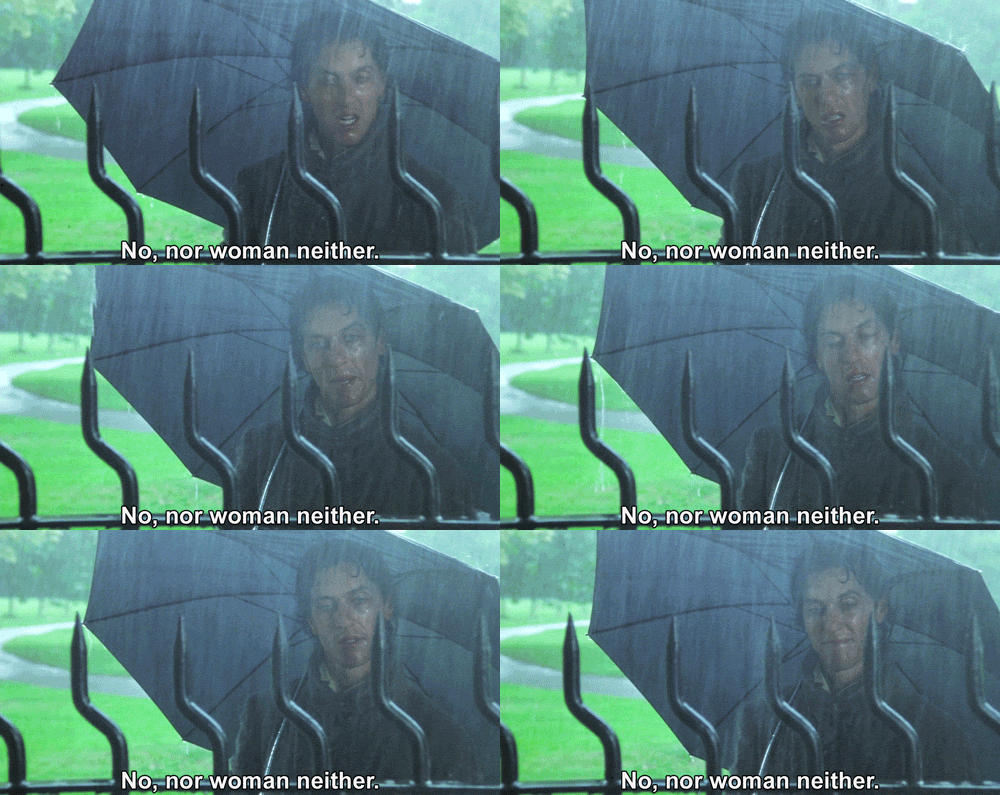
Honestly, “Man delights not me” would be a perfectly good way to end a speech explaining why Hamlet has been antisocial and rude at court, but there’s an final tacked-on line that I always find hilarious: “No, nor woman neither, though by your smiling you seem to say so.”
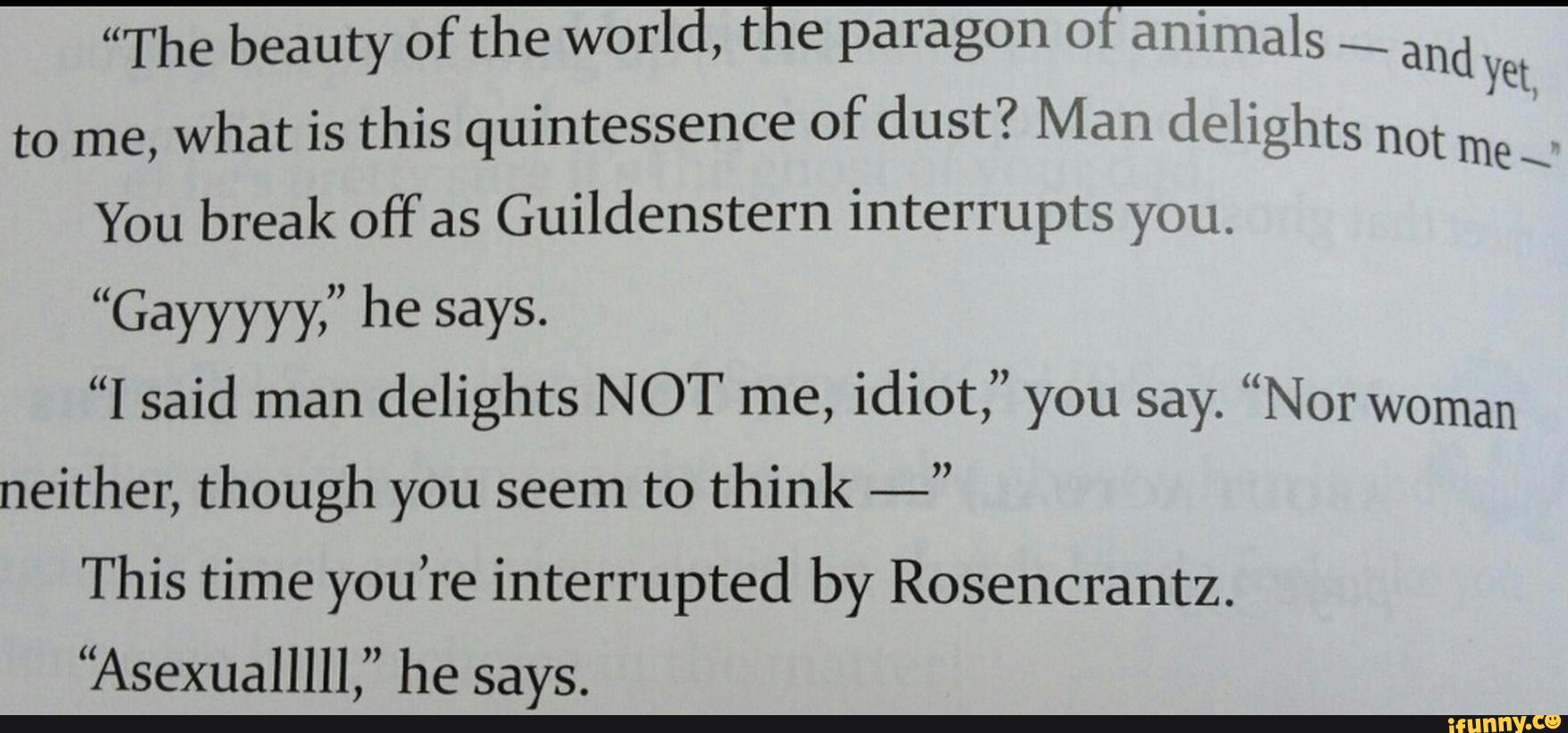
The speech ends as strangely as it began; Hamlet, preemptively annoyed at the joke he thinks his friends might make, doubles down on his insistence that he doesn’t enjoy anyone’s company.

There’s a strange appeal to me in Hamlet’s speech about how well-crafted humanity is, but how little that matters if he can’t find delight in his fellow humans.
The point, the goal, is both creation and delight.
It’s also just a really fun phrase. And it abbreviates to WAPOW! What more could you ask for?
Note: This draft was created in December 2019, and it’s now June 2021, and uh, I’m just gonna post it! Even if it’s not polished and could have about five more sections and a more solid thesis and wrap-up. Whatever! Have some words and gifs. 😀